Exercise 1
Vocabulary ボキャブラリー
(/ɡeɪt/)
名詞
歩行、歩き方
A person’s manner of walking.
Example: Wearable sensors are highly effective for providing real-time gait biofeedback during physical therapy.
ウェアラブルセンサーは、理学療法中にリアルタイムの歩行バイオフィードバックを提供するのに非常に効果的です。
(/ˌbrædɪkɪˈniːziə/)
名詞
動作緩慢、運動緩慢
Slowness of movement, a classic symptom of Parkinson’s disease.
Example: The hybrid sensing system can detect bradykinesia in Parkinson’s disease patients with high accuracy.
ハイブリッドセンシングシステムは、パーキンソン病患者の動作緩慢を高精度で検出することができます。
(/ˌɒstioʊɑːrˈθraɪtɪs/)
名詞
変形性関節症
A type of arthritis caused by the breakdown of joint cartilage and underlying bone.
Example: Biofeedback systems reduce joint stress for patients suffering from knee osteoarthritis.
バイオフィードバックシステムは、膝変形性関節症に悩む患者の関節への負荷を軽減します。
(/ˌkɪnɪˈmætɪk/)
形容詞
運動学的な、運動学の
Relating to the motion of bodies without reference to the forces that cause it.
Example: Clinicians use kinematic data to see if a patient is recovering original movement patterns.
臨床医は運動学的データを使用して、患者が本来の運動パターンを回復しているかどうかを確認します。
(/ˈætrəfi/)
名詞 / 動詞
萎縮(する)、筋萎縮
The wasting away or reduction in size of a body tissue or organ.
Example: Targeting specific muscles during rehabilitation can help prevent muscle atrophy.
リハビリテーション中に特定の筋肉を標的にすることは、筋萎縮を防ぐのに役立ちます。
Exercise 2
Medical Article
※AI音声
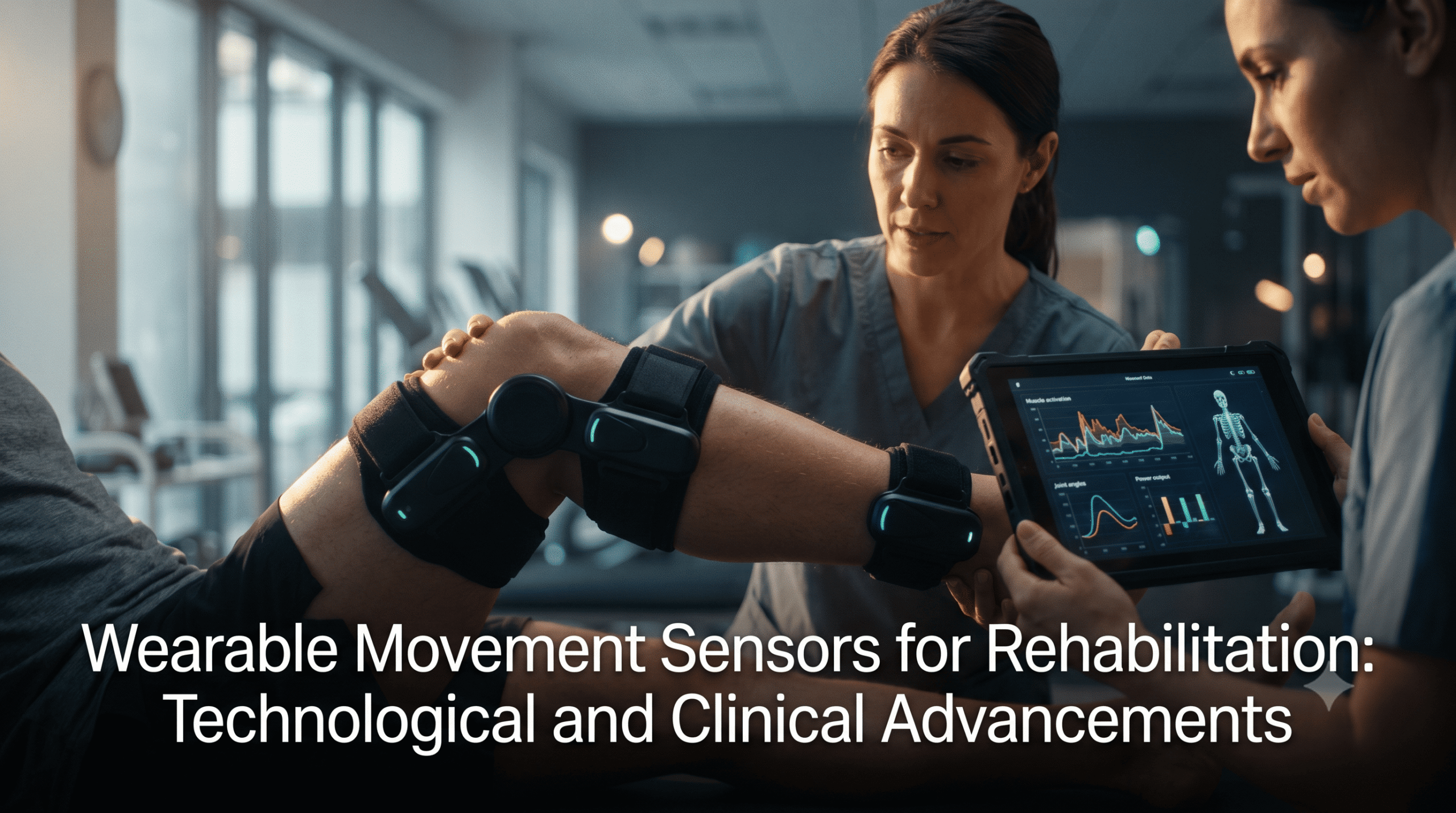
Executive Summary: Wearable movement sensors are transforming physical rehabilitation.
These portable, low-cost, and unobtrusive technologies track motor behavior in both clinical and real-world environments.
By providing precise, long-term data, they enable personalized and precision medicine.
Technological Diversity: Ranges from traditional IMUs to next-generation soft, textile-based “smart” clothing.
Clinical Efficacy: Used for automating clinical tests, providing real-time gait biofeedback, and monitoring stroke, Parkinson’s Disease (PD), and knee osteoarthritis.
Emerging Capabilities: Identifies early disease biomarkers, distinguishes true recovery from compensation, and enables remote tele-rehabilitation.
Next-Gen Integration: Hybrid and textile sensors offer discrete, long-term monitoring of neural and mechanical motor control.
1. State-of-the-Art Sensor Technologies
Current rehabilitation practices combine different types of sensors to overcome individual limitations and provide a complete view of movement.
Force-Based Sensors: These devices measure ground interaction using load-sensitive switches.
They are excellent for detecting gait phases and driving biofeedback, but they are prone to mechanical wear and environmental drift.
Gyroscopes: These sensors detect angular motion rates via Coriolis forces.
While they are immune to gravity and heel-strike vibrations, their data tends to drift over time during mathematical integration.
Accelerometers: By using mass-spring systems to measure speed changes, these are ideal for continuous tracking of daily activities.
However, they are affected by gravity and unreliable for non-dynamic events.
Magnetometers: These track the Earth’s magnetic field to provide compass headings and body orientation.
For dynamic accuracy, they usually need to be integrated with other sensors.
Inertial Measurement Units (IMUs): These combine accelerometers, gyroscopes, and magnetometers into one device.
They achieve optimized performance through sensor fusion, though they require complex algorithms to correct individual signal errors.
2. Current Clinical Applications
Neurological Rehabilitation Stroke: IMUs assess movement quality during walking tests.
Wearable monitors track real-world home performance, while biofeedback systems improve balance effectively.
Movement Disorders (PD & HD): In PD, sensors detect tremors, bradykinesia, and motor fluctuations.
In Huntington’s Disease (HD), they identify abnormal trunk movements and early balance decline.
Orthopedic Rehabilitation Knee Osteoarthritis (OA): Sensors link inactivity to functional decline.
Biofeedback systems reduce joint stress (knee adduction moment) by an average of 14.2% via weight-shifting. Running Injuries: Accelerometers measure impact shock on the shin.
Real-time feedback on cadence and foot-strike patterns helps resolve chronic pain in natural running environments.
3. Emerging Clinical Frontiers
Motor Biomarkers: Sensors detect subtle signs of disease before clinical symptoms appear.
For example, lower-back sensors can identify gait irregularities in asymptomatic genetic carriers of PD. Restitution vs.
Compensation: Clinicians use muscle sensors (sEMG) and kinematic data to see if a patient is recovering original movement patterns (restitution) or just using alternative muscles to adapt (compensation).
Tele-rehabilitation & Robotics: Wearables allow continuous home monitoring to check patient compliance.
Additionally, lightweight “soft robotic exosuits” use integrated sensors to restore normal walking in stroke survivors.
4. Next-Generation Sensor Innovations
Non-Invasive Neural Monitoring: Advanced sEMG combined with AI can now track individual motoneuron firing.
This reveals whether therapy is fixing underlying neural deficits or just altering mechanical movement, helping patients target specific muscles to prevent atrophy.
Hybrid Sensing Systems Hybrid sensors combine motion data (IMUs) with muscle activity (sEMG) in one device, achieving high accuracy.
Stroke Activity: Tracks daily tasks with 95.0% sensitivity.
PD Tremors: Tracks symptoms with 94.9% sensitivity using one sensor per limb.
Bradykinesia: Provides whole-body detection with 95.0% average accuracy.
Soft and Textile-Based Sensors Epidermal Electronics: Sensor “tattoos” that are mechanically unnoticeable.
Smart Apparel: Washable, comfortable gloves and socks made of conductive fabric.
Targeted Feedback: Stretchable arch sensors remind runners with plantar fasciitis to engage foot muscles when their arch drops.
5. Implementation Considerations and Limitations
Clinimetric Properties: Device reliability varies.
In a review of 73 PD devices, only 9 were fully recommended due to data gaps.
Technical Constraints: High-impact activities like running require high sampling rates (500–1000Hz) and high-range accelerometers (>16g) that commercial devices often lack.
Data Security & Standardization: Tele-rehabilitation requires strict data privacy rules and standardized metrics across different patient populations to ensure consistent clinical results.
要約: ウェアラブル運動センサーは、物理的リハビリテーションに変革をもたらしています。
これらのポータブルで低コスト、かつ目立たない技術は、臨床環境と実世界の環境の両方で運動行動を追跡します。
正確かつ長期的なデータを提供することで、個別化医療や精密医療を可能にします。
技術の多様性:従来のIMUから、次世代の柔軟な繊維ベースの「スマート」クロージング(衣服)まで多岐にわたります。
臨床的有効性:臨床検査の自動化、リアルタイムの歩行バイオフィードバックの提供、ならびに脳卒中、パーキンソン病(PD)、膝変形性関節症のモニタリングに使用されます。
新たな可能性:疾患の早期バイオマーカーの特定、代償動作からの真の回復の区別、および遠隔リハビリテーションを可能にします。
次世代の統合:ハイブリッドセンサーや繊維センサーにより、神経および機械的な運動制御の目立たない長期モニタリングが可能になります。
1.最先端のセンサー技術
現在のリハビリテーションの実践では、個々の限界を克服し、運動の全体像を把握するために、異なるタイプのセンサーを組み合わせています。
力ベースのセンサー:これらのデバイスは、荷重に敏感なスイッチを使用して地面との相互作用を測定します。
歩行周期の検出やバイオフィードバックの推進に優れていますが、機械的な摩耗や環境によるドリフトが生じやすい傾向があります。
ジャイロスコープ:これらのセンサーは、コリオリの力を介して角運動速度を検出します。
重力や踵接地時の振動の影響を受けない一方で、数学的な積分を行う際にデータが時間の経過とともにドリフト(ブレ)する傾向があります。
加速度計:質量スプリングシステムを用いて速度の変化を測定することにより、日常活動の継続的な追跡に理想的です。
しかし、重力の影響を受け、非動的な事象に対しては信頼性が低くなります。
磁気計:これらは地球の磁場を追跡し、方位磁針の方向や身体の向きを提供します。
動的な正確性を得るためには、通常、他のセンサーと統合する必要があります。
慣性計測装置(IMU):これらは加速度計、ジャイロスコープ、磁気計を1つのデバイスに組み合わせたものです。
個々の信号エラーを修正するために複雑なアルゴリズムが必要ですが、センサーフュージョン(センサー融合)を通じて最適化された性能を実現します。
2. 現在の臨床応用
神経リハビリテーション 脳卒中:IMUは歩行テスト中の運動の質を評価します。
ウェアラブルモニターは実世界の自宅でのパフォーマンスを追跡し、バイオフィードバックシステムはバランスを効果的に改善します。
運動障害(PDおよびHD):PDにおいて、センサーは振戦、動作緩慢、運動変動を検出します。
ハンチントン病(HD)では、異常な体幹運動や早期のバランス低下を特定します。
整形外科リハビリテーション 膝変形性関節症(OA):センサーは活動性の低下と機能低下を結びつけます。
バイオフィードバックシステムは、体重移動を介して関節への負荷(膝内転モーメント)を平均14.2%減少させます。
ランニング障害:加速度計は脛(すね)への衝撃を測定します。
ケイデンス(足の回転数)や着地パターンに関するリアルタイムのフィードバックは、自然なランニング環境における慢性的な痛みの解決に役立ちます。
3. 新たな臨床の最前線
運動バイオマーカー:センサーは、臨床症状が現れる前に疾患の微候を検出します。
例えば、腰部に装着したセンサーは、無症状の遺伝的PDキャリアにおける歩行の異常を特定することができます。
回復 vs 代償:臨床医は、筋肉センサー(表面筋電図:sEMG)と運動学的データを使用して、患者が本来の運動パターンを回復しているのか(回復)、あるいは単に別の筋肉を使用して適応しているだけなのか(代償)を確認します。
遠隔リハビリテーション&ロボティクス:ウェアラブルは、患者の遵守状況を確認するための継続的な自宅モニタリングを可能にします。
さらに、軽量の「ソフトロボット外骨格スーツ」は、統合されたセンサーを使用して脳卒中サバイバーの正常な歩行を回復させます。
4. 次世代センサーのイノベーション
非侵襲的神経モニタリング AIと組み合わせた先進的なsEMGは、現在、個々の運動ニューロンの発火を追跡することができます。
これにより、治療が根本的な神経欠損を修復しているのか、あるいは単に機械的な運動を変化させているだけなのかが明らかになり、患者が特定の筋肉を標的にして筋萎縮を防ぐのに役立ちます。
ハイブリッドセンシングシステム ハイブリッドセンサーは、運動データ(IMU)と筋肉活動(sEMG)を1つのデバイスに組み合わせ、高い精度を実現します。
脳卒中の活動:95.0%の感度で日常のタスクを追跡します。
PDの振戦:1肢あたり1つのセンサーを使用し、94.9%の感度で症状を追跡します。
動作緩慢:平均95.0%の正確さで全身の検出を提供します。
柔軟・繊維ベースのセンサー 表皮エレクトロニクス:機械的に装着していることを感じさせないセンサー「タトゥー」。
スマートアパレル:導電性ファブリックで作られた、洗濯可能で快適な手袋や靴下。
ターゲットフィードバック:伸縮性のある足弓(土踏まず)センサーは、足弓が下がったときに足の筋肉を働かせるよう、足底腱膜炎のランナーに促します。
5. 導入における考慮事項と限界
臨床測定学的特性:デバイスの信頼性は異なります。
73のPDデバイスをレビューしたところ、データ欠損のため、完全に推奨されたのはわずか9つでした。
技術的制約:ランニングのような衝撃の強い活動には、高いサンプリングレート(500〜1000Hz)と高範囲の加速度計(>16g)が必要ですが、市販のデバイスにはこれらが不足していることがよくあります。
データセキュリティと標準化:遠隔リハビリテーションでは、一貫した臨床結果を保証するために、厳格なデータプライリビールールと、異なる患者集団間での標準化された指標が必要です。
Exercise 3
Discussion ディスカッション
Q: What are the main benefits of using wearable movement sensors in physical rehabilitation?
物理的リハビリテーションにおいてウェアラブル運動センサーを使用することの主なメリットは何ですか?
Q: Which three types of sensors are combined to form an Inertial Measurement Unit (IMU)?
慣性計測装置(IMU)を構成するために、どの3種類のセンサーが組み合わされていますか?
Q: How much can biofeedback systems reduce joint stress in patients with knee osteoarthritis?
バイオフィードバックシステムは、膝変形性関節症の患者の関節負荷を平均でどのくらい減少させることができますか?
Q: What is the difference between ‘restitution’ and ‘compensation’ in patient recovery?
患者の回復における「回復(restitution)」と「代償(compensation)」の違いは何ですか?
Q: Why do high-impact activities like running require specific technical specifications in sensors?
ランニングのような衝撃の強い活動において、センサーに特定の技術的仕様が必要とされるのはなぜですか?
Exercise 4
Further Discussion 一歩踏み込んだディスカッション
Q: How could you integrate wearable sensors into your current physical therapy or acupuncture practice?
現在の理学療法や鍼灸の実践において、ウェアラブルセンサーをどのように統合できると思いますか?
Q: Do you think real-world home monitoring data is more valuable than data collected inside a clinic? Why or why not?
実世界の自宅モニタリングデータは、院内で収集されたデータよりも価値があると思いますか?その理由は何ですか?
Q: What challenges do you foresee when explaining sensor data or biofeedback to elderly patients?
高齢の患者にセンサーデータやバイオフィードバックについて説明する際、どのような課題が予測されますか?
Q: How might ‘smart apparel’ change the future of preventive medicine and sports injury rehabilitation?
「スマートアパレル」は、予防医療やスポーツ傷害リハビリテーションの未来をどのように変える可能性があると思いますか?
Q: In your opinion, how can clinicians balance the use of advanced AI technology with personalized, hands-on patient care?
臨床医は、先進的なAI技術の利用と、個別化された手技による患者ケアをどのようにバランスさせるべきだと思いますか?
Reference
Wearable Movement Sensors for Rehabilitation: A Focused Review of Technological and Clinical Advances
Franchino Porciuncula, Anna Virginia Roto, Deepak Kumar, Irene Davis, Serge Roy, Conor J Walsh, Louis N Awad
URL:https://pmc.ncbi.nlm.nih.gov/articles/PMC6700726/