Exercise 1
Vocabulary ボキャブラリー
(/ˈɪskiəl tjuːbəˈrɒsəti/)
名詞
坐骨結節
The rounded bone extending from the ischium of the pelvis.
Example: The common origin for most hamstring muscles is the ischial tuberosity.
ほとんどのハムストリング筋の共通の起始部は坐骨結節である。
(/ˈbaɪseps ˈfemərɪs/)
名詞
大腿二頭筋
A muscle of the posterior thigh that has two heads.
Example: The biceps femoris long head arises from the medial facet of the ischial tuberosity.
大腿二頭筋長頭は坐骨結節の内側から起始する。
(/ˌpæθəʊˌfɪziˈɒlədʒi/)
名詞
病態生理学
The functional changes that accompany a particular disease or injury.
Example: Understanding the pathophysiology of hamstring tears is vital for rehabilitation.
ハムストリング断裂の病態生理を理解することはリハビリテーションにおいて不可欠である。
(/rɪˈtrækʃən/)
名詞
収縮、後退
The action of drawing something back or in.
Example: Grade 3 injuries involve complete discontinuity with retraction of muscle ends.
グレード3の損傷は、筋端の収縮を伴う完全な離断を含む。
(/hɪp ˈflekʃən/)
名詞
股関節屈曲
Movement that decreases the angle between the thigh and the pelvis.
Example: A forceful hip flexion moment can lead to a macro-traumatic hamstring event.
強力な股関節屈曲モーメントは、ハムストリングの大きな外傷的事象につながる可能性がある。
Exercise 2
Medical Article
※AI音声
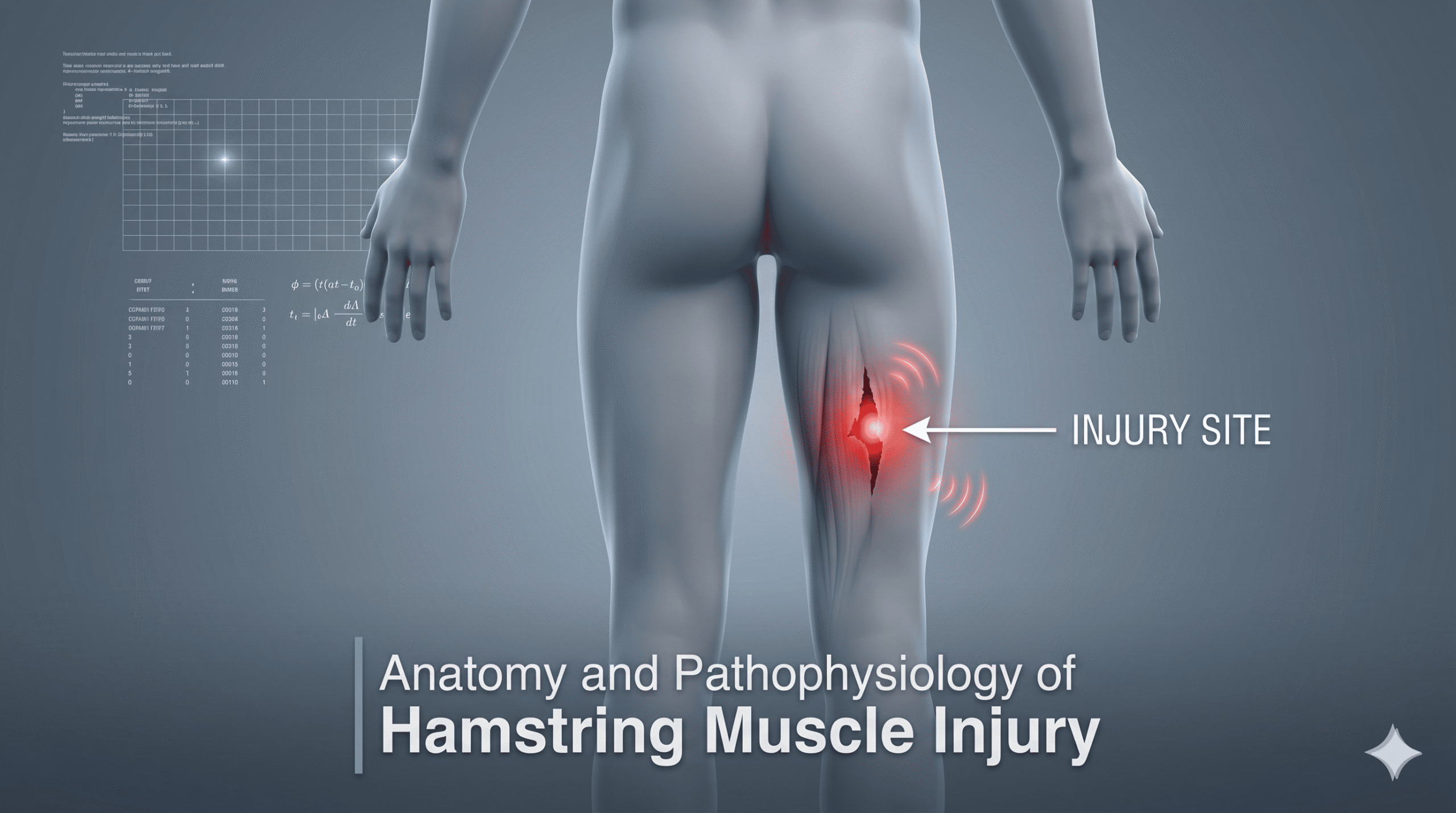
The hamstring is composed of 3 main muscles: the biceps femoris (long and short head), semitendinosus, and semimembranosus.
The semitendinosus and long head of the biceps share a common origin, which is the ischial tuberosity.
The long head of the biceps femoris arises from the medial facet of the ischial tuberosity and the short head of the biceps femoris arises from the lateral aspect of the linea aspera, the lateral supracondylar line, and the intermuscular septum.
The semimembranosus originates more superiorly on the ischial tuberosity compared with the semitendinosus and biceps femoris.
Hamstring injuries can occur from repetitive microscopic muscle damage or a single event exceeding the limits of the muscle-tendon unit.
Some injuries may occur from a decline in tissue integrity due to repetitive damage.
A macro-traumatic event can occur where there is a forceful and rapid hip flexion moment.
Hamstring injuries can be categorized into 3 categories: active or passive high muscle-tendon unit forces, muscle-tendon unit lengthening beyond moderate lengths, and high-velocity movements.
Hamstring injuries are classified on a scale of 1 to 3:
Grade 1 injuries (hamstring strain) are defined as <5% muscle disruption, Grade 2 injuries (partial hamstring tear) as >5% muscle disruption and no retraction of muscle ends, and Grade 3 (complete hamstring tear) as complete discontinuity of muscle fibers with retraction of muscle ends.
ハムストリングスは、大腿二頭筋(長頭および短頭)、半腱様筋、半膜様筋の3つの主要な筋肉で構成されています。
半腱様筋と大腿二頭筋長頭は、共通の起始部である坐骨結節を共有しています。
大腿二頭筋長頭は坐骨結節の内側から起始し、大腿二頭筋短頭は大腿骨粗線外側唇、外側上顆線、および筋間中隔から起始します。
半膜様筋は、半腱様筋や大腿二頭筋と比較して坐骨結節のより上部から起始します。
ハムストリングスの損傷は、繰り返される微細な筋肉の損傷、または筋腱単位の限界を超える単一の事象によって発生する可能性があります。
繰り返される損傷による組織の完全性の低下から発生する損傷もあります。
強力かつ急速な股関節屈曲モーメントが生じる際に、大きな外傷的イベントが発生することがあります。
ハムストリングス損傷は、能動的または受動的な高い筋腱単位の力、中等度を超える筋腱単位の延長、および高速運動の3つのカテゴリーに分類できます。
ハムストリングス損傷はグレード1から3の尺度で分類されます。
グレード1(肉離れ)は筋肉の断裂が5%未満、グレード2(部分断裂)は筋肉の断裂が5%超で筋端の収縮がないもの、グレード3(完全断裂)は筋端の収縮を伴う筋線維の完全な離断と定義されています。
Exercise 3
Discussion ディスカッション
Q: Which three muscles make up the hamstring group?
ハムストリングスを構成する3つの筋肉は何ですか?
Q: What is the common origin for the semitendinosus and the long head of the biceps?
半腱様筋と大腿二頭筋長頭に共通する起始部は何ですか?
Q: What are the two primary ways hamstring injuries can occur?
ハムストリングス損傷が発生する主な2つの方法は何ですか?
Q: How is a grade 2 hamstring injury defined in terms of muscle disruption?
筋肉の断裂に関して、グレード2のハムストリング損傷はどのように定義されますか?
Q: What distinguishes a grade 3 injury from a grade 2 injury?
グレード3の損傷とグレード2の損傷を区別するものは何ですか?
Exercise 4
Further Discussion 一歩踏み込んだディスカッション
Q: Based on the anatomy described, why might a high-kicking motion cause a hamstring tear?
説明された解剖学的構造に基づくと、なぜ高いキック動作がハムストリングの断裂を引き起こす可能性があるのでしょうか?
Q: In your clinical experience, which sport results in the most frequent grade 2 or 3 hamstring injuries?
あなたの臨床経験において、グレード2または3のハムストリング損傷が最も頻繁に起こるスポーツは何ですか?
Q: How does the ‘retraction’ mentioned in grade 3 injuries complicate the recovery process?
グレード3の損傷で言及されている「収縮(後退)」は、回復プロセスをどのように複雑にしますか?
Q: What preventive exercises would you recommend to improve the tissue integrity of the hamstrings?
ハムストリングの組織の完全性を向上させるために、どのような予防エクササイズを推奨しますか?
Q: Why is it important to differentiate between microscopic damage and macro-traumatic events during a patient assessment?
患者の評価において、微細な損傷と大きな外傷的イベントを区別することがなぜ重要なのですか?
Reference
Prevention and Rehabilitation of the Athletic Hamstring Injury
Adriana Geraci P.T., D.P.T. , Delaney Mahon P.T., D.P.T. , Eric Hu B.S. , Jesus E. Cervantes B.S. , Shane J. Nho M.D., M.S.
URL:https://www.sciencedirect.com/science/article/pii/S2666061X24001640