
Exercise 1
Vocabulary ボキャブラリー
(/ˈmiːdiən nɜːrv/)
名詞
正中神経
A major nerve of the upper limb that provides sensation and motor function to parts of the hand.
Example: Carpal tunnel syndrome occurs when the median nerve is compressed at the wrist.
手根管症候群は、正中神経が手首で圧迫されることで発生します。
(/ˈruːmətɔɪd ɑːrˈθraɪtɪs/)
名詞
関節リウマチ
A chronic autoimmune disorder that causes inflammation and pain in the joints.
Example: Patients with rheumatoid arthritis have a higher risk of developing CTS.
関節リウマチの患者は、CTSを発症するリスクが高くなります。
(/ˈreɪdiəl/)
形容詞
橈骨の、橈側の
Relating to the radius bone or the thumb side of the hand and forearm.
Example: Numbness can be felt on the radial side of the ring finger.
しびれは薬指の橈骨(親指)側で感じられることがあります。
(/ɡrɪp strɛŋkθ/)
名詞
握力
The force applied by the hand to pull on or suspend from objects.
Example: Severe pain and nerve compression can lead to reduced grip strength.
深刻な痛みや神経の圧迫は、握力の低下につながる可能性があります。
(/ˌmʌskjəloʊˈskɛlɪtəl/)
形容詞
筋骨格の、筋骨格系の
Relating to the muscles and the skeleton.
Example: Carpal tunnel syndrome is a common musculoskeletal disorder among manual laborers.
手根管症候群は、肉体労働者の間で一般的な筋骨格系疾患です。
Exercise 2
Medical Article
※AI音声
Carpal tunnel syndrome (CTS) is a common medical condition that causes pain, numbness, and tingling in the hand and arm of the affected individual.
CTS occurs when the median nerve is squeezed or compressed as it travels through the wrist.
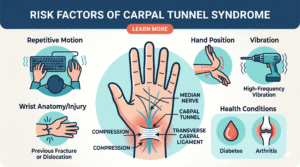
Risk factors for CTS include obesity, repetitive wrist activity, pregnancy, genetic predisposition, and rheumatoid arthritis.
The symptoms of CTS may vary across patients.
As such, they are classified differently into mild, moderate, and severe.
The syndrome is characterized by pain in the hand, numbness, and tingling in the distribution of the median nerve.
These sensations may be felt in the thumb, index finger, middle finger, and the radial side of the ring finger.
Painful feelings may lead to reduced grip strength and hand function.
The occurrence of CTS over a long time may also result in the muscles at the base of the thumb wasting away.
An estimated 4% and 5% of people suffer from CTS worldwide, with the most susceptible population being elderly individuals aged between 40 and 60 years.
CTS is also more prevalent amongst women than men.
For instance, the UK General Practice Research Database in 2000 evaluated that CTS prevalence was 88 per 100,000 in males, while in women, the incidence was 193 per 100,000.
More frequent evaluations of the incidence of CTS note its occurrence to be higher for women aged between 45 and 54 years, while the risk is higher for men aged between 75 and 84 years.
CTS is a musculoskeletal disorder associated with work activity in the affected individuals, which is caused by strain and repetitive activity, making it a common problem among manual laborers.
手根管症候群(CTS)は、罹患者の手や腕に痛み、しびれ、ピリピリとした感覚(刺痛)を引き起こす一般的な病態です。
CTSは、正中神経が手首を通過する際に圧迫されることで発生します。
CTSのリスク要因には、肥満、反復的な手首の動作、妊娠、遺伝的素因、関節リウマチなどがあります。
CTSの症状は患者によって異なる場合があるため、軽度、中等度、重度に分類されます。
この症候群は、手の痛み、および正中神経の支配領域におけるしびれやピリピリ感を特徴とします。
これらの感覚は、親指、人差し指、中指、そして薬指の橈骨(親指)側で感じられることがあります。
痛みを伴う感覚は、握力の低下や手機能の低下につながる可能性があります。
CTSが長期にわたって発生すると、親指の付け根の筋肉(母指球筋)が萎縮する原因にもなります。
世界中で推定4%から5%の人がCTSを患っており、最も影響を受けやすい集団は40歳から60歳の高齢層です。
また、CTSは男性よりも女性に多く見られます。
例えば、2000年の英国総合診療リサーチデータベースの評価によると、CTSの発症率は男性で10万人あたり88人であったのに対し、女性では10万人あたり193人でした。
CTSの発症率に関するより頻繁な調査では、女性では45歳から54歳の間で発生率が高く、男性では75歳から84歳の間でリスクが高くなることが指摘されています。
CTSは、罹患者の労働活動に関連する筋骨格系疾患であり、負担や反復動作によって引き起こされるため、肉体労働者の間で一般的な問題となっています。
Exercise 3
Discussion ディスカッション
Q: What physiological event causes carpal tunnel syndrome?
どのような生理学的現象が手根管症候群を引き起こしますか?
Q: According to the article, what are the risk factors for developing CTS?
記事によると、CTSを発症するリスク要因にはどのようなものがありますか?
Q: Which fingers can experience pain, numbness, and tingling due to CTS?
CTSによって、どの指に痛み、しびれ、ピリピリ感が生じる可能性がありますか?
Q: What long-term effect can CTS have on the muscles of the hand?
CTSは長期的に手の筋肉にどのような影響を与える可能性がありますか?
Q: Which gender and age groups have a higher prevalence or risk of CTS?
どの性別および年齢層が、CTSのより高い発症率またはリスクを持っていますか?
Exercise 4
Further Discussion 一歩踏み込んだディスカッション
Q: What kinds of manual labor or occupations do you think carry the highest risk for CTS in your area of expertise?
あなたの専門分野において、どのような肉体労働や職業がCTSの最も高いリスクを伴うと思いますか?
Q: How do physical therapists or acupuncturists typically assess and treat a patient suspected of having CTS?
理学療法士や鍼灸師は、CTSが疑われる患者を通常どのように評価し、治療しますか?
Q: What preventative exercises or ergonomic advice would you recommend to desk workers to avoid CTS?
デスクワーカーがCTSを回避するために、どのような予防エクササイズや人間工学的なアドバイスを推奨しますか?
Q: In severe cases where muscle wasting occurs, how does the prognosis change for conservative therapy versus surgical intervention?
筋肉の萎縮が見られる重症の場合、保存療法と外科的介入とで予後はどのように変わりますか?
Q: How can you differentiate carpal tunnel syndrome from cervical radiculopathy during a clinical examination?
臨床検査において、手根管症候群と頸椎神経根症をどのように鑑別しますか?
Reference
Carpal Tunnel Syndrome: A Review of Literature
Alessia Genova, Olivia Dix, Asem Saefan, Mala Thakur, Abbas Hassan
URL:https://pmc.ncbi.nlm.nih.gov/articles/PMC7164699/