Exercise 1
Vocabulary ボキャブラリー
(/ˌɪd.i.əˈpæθ.ɪk/)
形容詞
特発性の、原因不明の
Denoting any disease or condition which arises spontaneously or for which the cause is unknown.
Example: Many cases of carpal tunnel syndrome are classified as idiopathic because no specific cause can be identified.
特定の原因を特定できないため、手根管症候群の多くの症例は特発性に分類されます。
(/ˈflek.ʃən/)
名詞
屈曲
The action of bending or the condition of being bent, especially the bending of a limb or joint.
Example: Prolonged wrist flexion during typing can increase pressure on the median nerve.
タイピング中の長時間の腕関節の屈曲は、正中神経への圧迫を高める可能性があります。
(/ˌkoʊ.mɔːrˈbɪd.ə.t̬i/)
名詞
併存疾患、併存症
The simultaneous presence of two or more diseases or medical conditions in a patient.
Example: Diabetes is a common systemic comorbidity that significantly increases the risk of developing CTS.
糖尿病は、CTSを発症するリスクを著しく高める一般的な全身性併存疾患です。
(/ˈmiː.di.ən nɜːrv/)
名詞
正中神経
A major peripheral nerve of the upper limb that runs through the carpal tunnel and innervates the hand.
Example: Carpal tunnel syndrome occurs when the median nerve is compressed as it passes through the wrist.
手根管症候群は、正中神経が手首を通過する際に圧迫されることで発生します。
(/nʊˈrɑː.pə.θi/)
名詞
神経障害、神経病変
Disease or dysfunction of one or more peripheral nerves, typically causing numbness or weakness.
Example: Patients with diabetic neuropathy have a much higher prevalence of carpal tunnel syndrome.
糖尿病性神経障害を持つ患者は、手根管症候群の有病率が大幅に高くなります。
Exercise 2
Medical Article
※AI音声
Despite CTS being largely an idiopathic syndrome, numerous risk factors are associated with its prevalence.
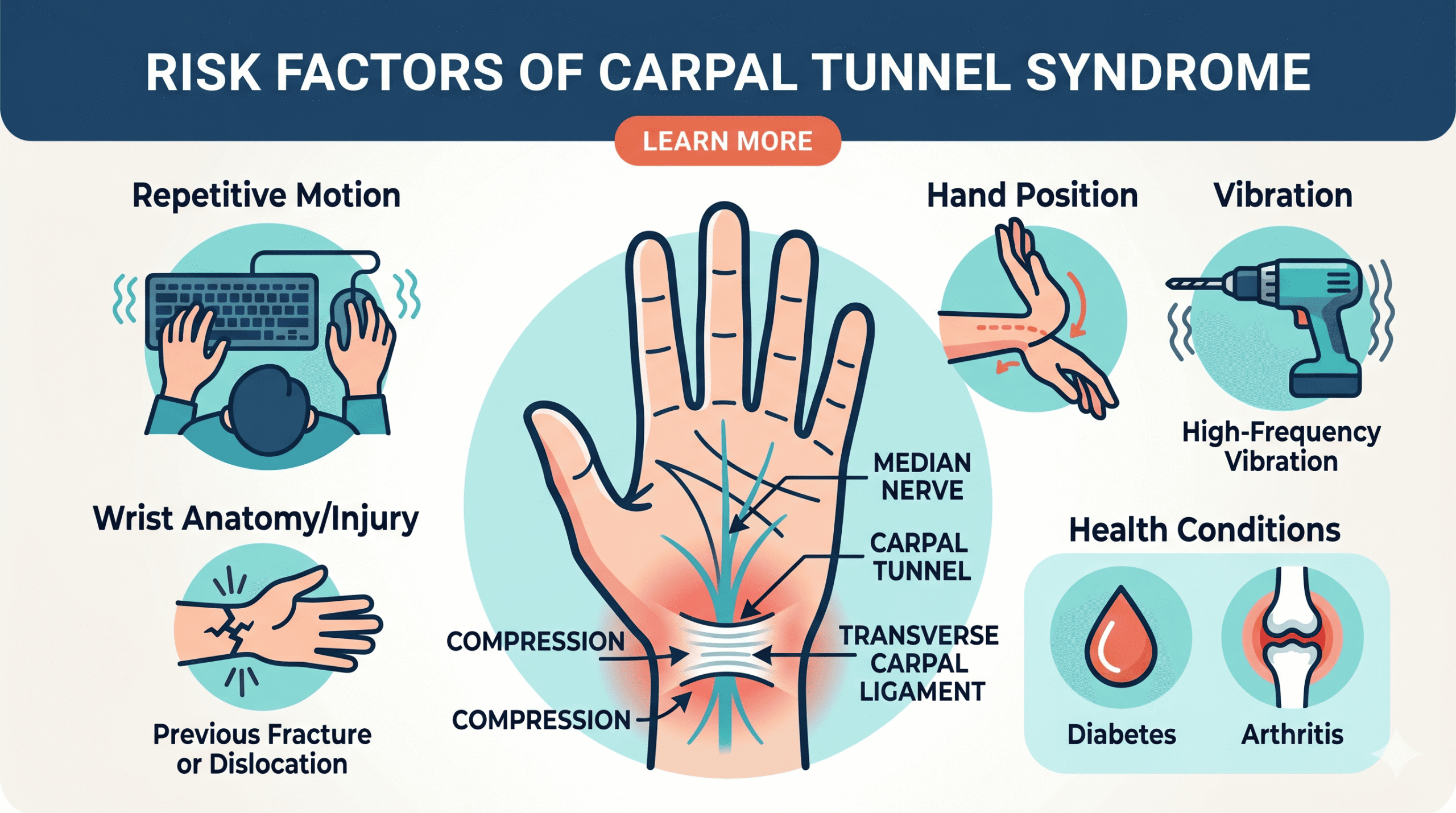
Notable occupational and environmental risk factors include prolonged wrist flexion or extension, repetitive use of the flexor muscles, and exposure to vibration.
Conversely, medical risk factors are broadly classified into four mechanical and neuropathic categories: (1) extrinsic factors that increase the volume within the tunnel; (2) intrinsic factors that increase the tissue volume within the tunnel; (3) structural factors that alter the contour of the tunnel; and (4) neuropathic factors.
Additionally, the rising incidence of CTS is attributed to an aging workforce and the increasing prevalence of systemic comorbidities, such as diabetes and pregnancy.
Extrinsic factors that increase intra-tunnel volume include conditions that alter fluid equilibrium, such as pregnancy, menopause, obesity, renal failure, hypothyroidism, use of oral contraceptives, and congestive heart failure.
Intrinsic factors that occupy space inside the tunnel include masses, tumors, and anatomical distortions, which may result directly from distal radius fractures or subsequent post-traumatic arthritis.
Neuropathic factors include conditions such as diabetes, alcoholism, vitamin deficiency or toxicity, and exposure to toxins.
These are significant because they affect the median nerve without necessarily increasing the interstitial pressure within the carpal tunnel.
Specifically, diabetic patients have a higher propensity for CTS due to a lower threshold for nerve injury.
In this population, the prevalence of CTS is 14% in patients without neuropathy and rises to 30% in those with diabetic neuropathy, whereas the prevalence during pregnancy is estimated at 2%.
手根管症候群(CTS)は大部分が特発性の症候群であるにもかかわらず、多くのリスク因子がその有病率に関連しています。
注目すべき職業的および環境的リスク因子には、長時間の手関節の屈曲または伸展、屈筋群の反復使用、そして振動への曝露が含まれます。
逆に、医学的リスク因子は機械的および神経病変的な4つのカテゴリーに広く分類されます:(1) 手根管内の容積を増加させる外因性因子、(2) 手根管内の組織量を増加させる内因性因子、(3) 手根管の輪郭を変化させる構造的因子、そして (4) 神経病変的因子です。
さらに、CTSの発症率の上昇は、労働人口の高年齢化や、糖尿病や妊娠などの全身性併存疾患の有病率の上昇に起因しています。
手根管内容積を増加させる外因性因子には、妊娠、閉経、肥満、腎不全、甲状腺機能低下症、経口避妊薬の使用、うっ血性心不全など、体液の平衡を変化させる病態が含まれます。
手根管内の空間を占拠する内因性因子には、腫瘤、腫瘍、解剖学的歪みなどがあり、これらは橈骨遠位端骨折やその後の外傷後関節炎から直接引き起こされる場合があります。
神経病変的因子には、糖尿病、アルコール中毒、ビタミン欠乏症または過剰症、毒素への曝露などの病態が含まれます。
これらが重要である理由は、手根管内の組織間圧を必ずしも上昇させることなく、正中神経に影響を及ぼすためです。
特に、糖尿病患者は神経損傷の閾値が低いため、CTSを発症する傾向が高くなります。
この人口集団において、CTSの有病率は神経障害のない患者で14%であり、糖尿病性神経障害のある患者では30%に上昇するのに対し、妊娠中の有病率は2%と推定されています。
Exercise 3
Discussion ディスカッション
Q: What are the notable occupational and environmental risk factors mentioned for CTS?
記事で言及されている、CTSの注目すべき職業的および環境的リスク因子は何ですか?
Q: Into how many medical categories are the risk factors for CTS broadly classified?
CTSの医学的リスク因子は、大きく何個のカテゴリーに分類されていますか?
Q: What conditions can cause extrinsic factors by altering fluid equilibrium?
体液の平衡を変化させることで外因性因子を引き起こす病態には、どのようなものがありますか?
Q: Why do neuropathic factors like diabetes affect the median nerve significantly?
糖尿病などの神経病変的因子が正中神経に大きな影響を与えるのはなぜですか?
Q: What is the prevalence of CTS in patients with diabetic neuropathy compared to those during pregnancy?
妊娠中の有病率と比較して、糖尿病性神経障害を持つ患者のCTSの有病率はどれくらいですか?
Exercise 4
Further Discussion 一歩踏み込んだディスカッション
Q: In your clinical practice, what types of occupational backgrounds do you most commonly see in patients complaining of CTS symptoms?
あなたの臨床経験において、CTSの症状を訴える患者に最も多く見られる職業的背景はどのようなものですか?
Q: How should physical therapists or acupuncturists modify their treatment approach when a CTS patient has systemic comorbidities like diabetes?
CTS患者に糖尿病などの全身性併存疾患がある場合、理学療法士や鍼灸師は治療アプローチをどのように修正すべきでしょうか?
Q: What ergonomic recommendations would you provide to a patient whose job involves prolonged wrist flexion and exposure to vibration?
長時間の腕関節の屈曲や振動への曝露を伴う仕事をしている患者に対して、どのような人間工学的なアドバイスを提供しますか?
Q: Considering the aging workforce, how do you think the role of preventative rehabilitation for CTS will change in the future?
労働人口の高年齢化を考慮すると、CTSに対する予防的リハビリテーションの役割は今後どのように変化していくと思いますか?
Q: Aside from conservative therapy, at what point would you recommend a patient consult an orthopedic surgeon for structural or intrinsic CTS factors?
保存療法以外で、構造的または内因的なCTS因子に対して、患者に整形外科医への受診を勧めるのはどのようなタイミングですか?
Reference
Carpal Tunnel Syndrome: A Review of Literature
Alessia Genova, Olivia Dix, Asem Saefan, Mala Thakur, Abbas Hassan
URL:https://pmc.ncbi.nlm.nih.gov/articles/PMC7164699/