
Exercise 1
Vocabulary ボキャブラリー
名詞句
前兆のない偏頭痛
A type of migraine that occurs without sensory warning signs like flashes of light.
Example: The trial enrolled 120 adults diagnosed with migraine without aura.
その試験には、前兆のない偏頭痛と診断された120人の成人が登録されました。
名詞句
シャム鍼、偽鍼
A placebo control procedure that mimics acupuncture but lacks specific therapeutic elements.
Example: The control group received superficial needling known as sham acupuncture.
対照群は、シャム鍼として知られる浅い刺鍼を受けました。
名詞句
得気(とくき)感覚
Characteristic sensations like soreness or numbness perceived during needle manipulation.
Example: Practitioners applied manual stimulation to elicit deqi sensation.
施術者は得気感覚を誘発するために手技による刺激を行いました。
名詞
機能的磁気共鳴画像法
A technique for measuring brain activity by detecting changes associated with blood flow.
Example: Researchers evaluated neurological mechanisms using resting-state fMRI.
研究者らは安静時fMRIを用いて神経学的メカニズムを評価しました。
名詞
視床
A brain structure that acts as a relay station for sensory information.
Example: The thalamus is involved in pain perception and treatment response.
視床は痛みの知覚と治療反応に関与しています。
Exercise 2
Medical Article
※AI音声
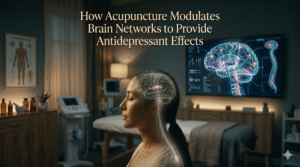
A randomized clinical trial involving 120 patients demonstrated that acupuncture significantly reduces migraine frequency and headache-related disability in patients without aura.
Participants receiving real acupuncture showed greater improvements in monthly migraine days, pain intensity, and acute medication use compared to a sham acupuncture control group.
The study utilized a standardized set of eight acupoints, including Baihui (GV20) and Hegu (LI4), with manual stimulation to elicit the ‘deqi’ sensation.
Researchers also used functional magnetic resonance imaging (fMRI) to explore the neurobiological mechanisms behind these clinical improvements.
They discovered that baseline brain connectivity patterns could predict a patient’s response to treatment.
Specifically, connectivity involving the limbic system, prefrontal cortex, and thalamus—areas responsible for pain perception and emotional regulation—was associated with reductions in pain intensity and disability.
The trial concluded that acupuncture is a safe and effective intervention, with only mild and uncommon adverse events reported.
The findings suggest that neurological biomarkers could eventually help identify which patients are most likely to benefit from acupuncture, paving the way for more individualized treatment strategies in clinical practice.
120人の患者を対象としたランダム化比較試験により、鍼治療が前兆のない偏頭痛患者の偏頭痛の頻度と頭痛に関連する障害を有意に軽減することが示されました。
本物の鍼治療を受けた参加者は、シャム(偽)鍼コントロール群と比較して、月間の偏頭痛の日数、痛みの強さ、および急性期治療薬の使用量において大きな改善を示しました。
この研究では、百会(GV20)や合谷(LI4)を含む8つの標準化された経穴を使用し、手技による刺激で「得気(とくき)」感覚を誘発させました。
研究者らはまた、これらの臨床的改善の背後にある神経生物学的メカニズムを解明するために、機能的磁気共鳴画像法(fMRI)を用いました。
その結果、安静時の脳のネットワーク接続パターンから、患者の治療に対する反応を予測できることが判明しました。
具体的には、痛みの知覚や感情調節を司る領域である大脳辺縁系、前頭前野、視床に関わる接続性が、痛みの強度や障害の軽減と関連していました。
この試験は、鍼治療が安全で効果的な介入であり、報告された有害事象は軽微でまれであったと結論付けました。
これらの知見は、神経学的バイオマーカーが、将来的にどの患者が鍼治療から最も恩恵を受けやすいかを特定するのに役立ち、臨床現場におけるより個別化された治療戦略への道を開く可能性を示唆しています。
Exercise 3
Discussion ディスカッション
Q: What were the main clinical outcomes for patients in the acupuncture group?
鍼治療群の患者における主な臨床結果は何でしたか?
Q: Which specific acupoints were used in the standardized treatment protocol?
標準化された治療プロトコルでは、どの特定の経穴が使用されましたか?
Q: How was ‘deqi’ defined in this clinical trial?
この臨床試験において「得気」はどのように定義されましたか?
Q: What role did fMRI play in this research study?
この研究においてfMRIはどのような役割を果たしましたか?
Q: What were the reported adverse events, and how common were they?
報告された有害事象は何でしたか、またそれらはどの程度一般的でしたか?
Exercise 4
Further Discussion 一歩踏み込んだディスカッション
Q: How do you explain the ‘deqi’ sensation to a patient who is receiving acupuncture for the first time?
初めて鍼治療を受ける患者に対して、「得気」の感覚をどのように説明しますか?
Q: Why is it difficult to create a perfect placebo (sham) control for acupuncture trials?
鍼治療の試験において、完璧なプラセボ(シャム)対照を作るのが難しいのはなぜでしょうか?
Q: How might neuroimaging markers change the way you select patients for acupuncture therapy in the future?
将来、神経画像の指標は、鍼治療に適した患者を選択する方法をどのように変える可能性があると思いますか?
Q: In your clinical practice, how do you measure ‘headache-related disability’ or patient progress?
あなたの臨床現場では、「頭痛に関連する障害」や患者の経過をどのように測定していますか?
Q: Do you believe standardized point prescriptions are more effective than individualized ones for migraine treatment?
偏頭痛の治療において、標準化された経穴処方は個別化されたものよりも効果的だと思いますか?
Source
Xinyu Zhang et al. Acupuncture for Migraine Without Aura and Connection-Based Efficacy Prediction: A Randomized Clinical Trial. JAMA Network Open. 2026.
https://jamanetwork.com/journals/jamanetworkopen/fullarticle/2844379