Exercise 1
Vocabulary ボキャブラリー
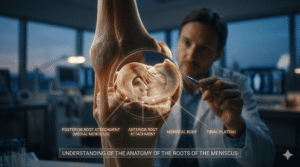
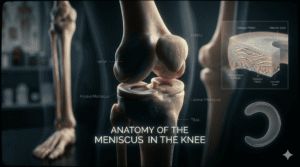
(/mɪˈnɪskəs/)
名詞
半月板
A crescent-shaped fibrocartilaginous structure in the knee joint.
Example: The meniscus helps to distribute weight and absorb shock in the knee.
半月板は膝にかかる荷重を分散させ、衝撃を吸収する役割を果たします。
(/dʒeˈsteɪʃən/)
名詞
妊娠(期間)
The process or period of developing inside the womb between conception and birth.
Example: During gestation, the fetal skeletal system undergoes rapid development.
妊娠期間中、胎児の骨格系は急速な発達を遂げます。
(/ˈvæskjʊləraɪzd/)
形容詞
血管化した、血管が分布した
Provided with vessels or an adequate blood supply.
Example: Prenatal menisci are highly vascularized compared to adult ones.
出生前の半月板は、成人のものと比較して高度に血管化されています。
(/eɪˈvæskjʊlər/)
形容詞
無血管の、血管のない
Having few or no blood vessels.
Example: The central region of the mature meniscus becomes avascular.
成熟した半月板の中央領域は無血管になります。
(/ˈdɪskɔɪd/)
形容詞
盤状の、ディスコイドの
Having a flat, circular shape like a disc.
Example: A discoid lateral meniscus is a congenital variant that is prone to tearing.
盤状外側半月板は、断裂を起こしやすい先天性の変異です。
Exercise 2
Medical Article
※AI音声
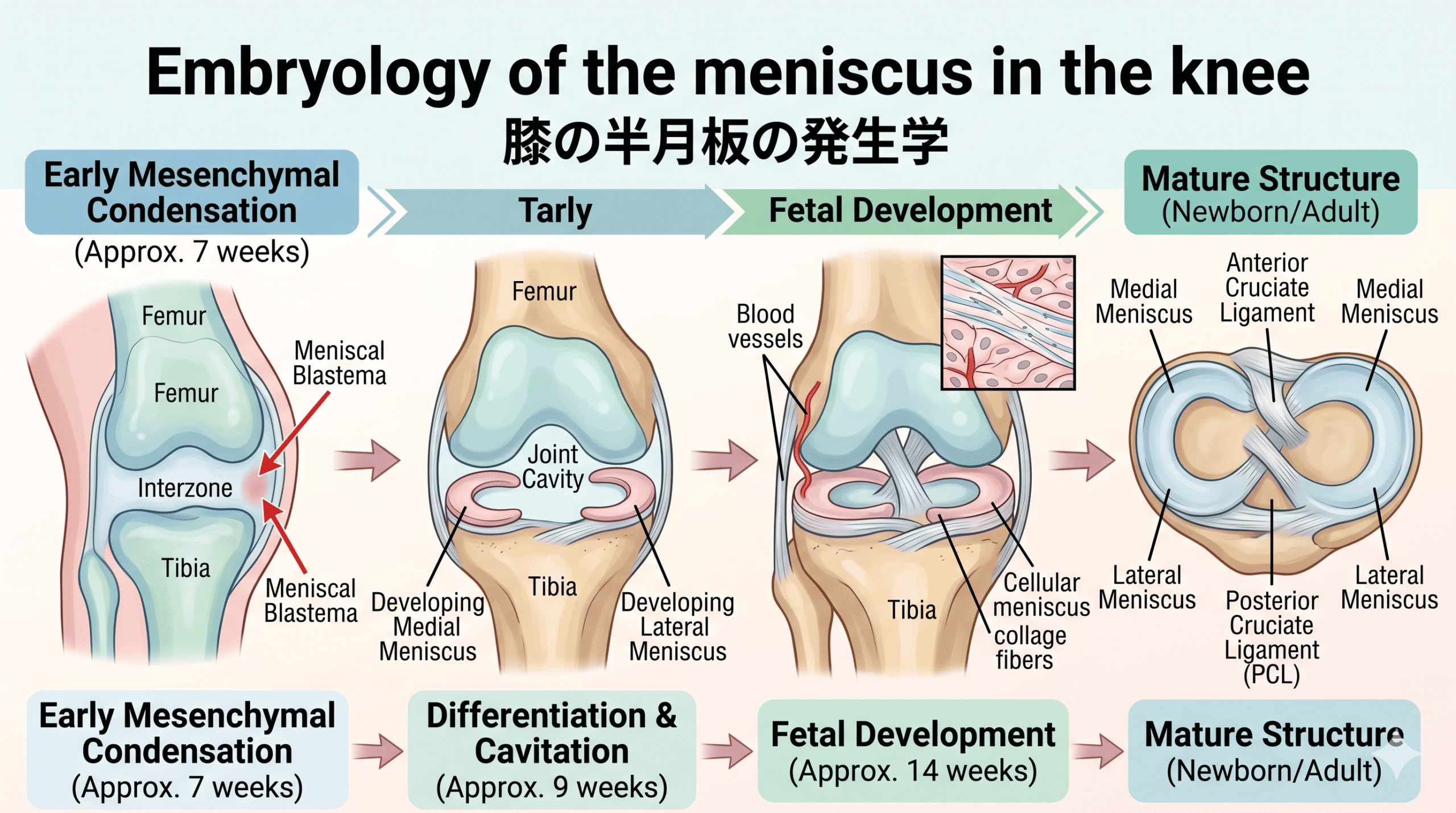
During gestation, the menisci form from the intermediate layer of the mesenchymal tissue and differentiate within the limb bud.
The normal menisci can be defined by week 8 of gestation and form their mature anatomic shape by week 14.
Throughout prenatal development, the menisci are highly vascularized and receive vessels from the capsular and tibial attachments to the inner third of the menisci.
During this time, the meniscus remains highly cellular with a large nuclear/cytoplasmic ratio.
After birth, the vascularity and cellularity of the menisci gradually recede as the collagen content continues to increase.
By 9 months of life, the central third of the meniscus is avascular, and by 10 years of age, the vascularity and structure resemble those of an adult knee.
While this transition is gradual over the first decade of life, the lateral meniscus demonstrates more variability throughout development.
Occasionally, this variability leads to alterations in the organization of the collagen fibers and can result in a hypertrophic, discoid, or unstable lateral meniscus.
However, in most cases, as the menisci grow, the ratio of the area of each meniscus to the area of the corresponding tibial plateau, as well as the ratio of the area of the medial meniscus to the lateral meniscus, remains fairly consistent and uniform.
妊娠期間中、半月板は間葉組織の中間層から形成され、肢芽(しが)の内部で分化します。
通常の半月板は妊娠8週までに確認できるようになり、14週までに成熟した解剖学的形状を形成します。
出生前の発育期間を通じて、半月板は高度に血管化されており、関節包および脛骨の付着部から半月板の内側3分の1に達する血管を受け取っています。
この時期、半月板は細胞密度が非常に高く、核/細胞質比が大きい状態を維持しています。
出生後、コラーゲン含有量が増加し続けるにつれて、半月板の血管分布と細胞密度は徐々に減少します。
生後9ヶ月までに半月板の中央3分の1は無血管となり、10歳になる頃には血管分布と構造が成人の膝のそれと類似するようになります。
この移行は人生の最初の10年間にわたり緩やかに行われますが、外側半月板は発育を通じてより大きな多様性(変動)を示します。
時に、この多様性がコラーゲン繊維の組織化の変化をもたらし、肥大性、盤状(ディスコイド)、または不安定な外側半月板を引き起こすことがあります。
しかし、ほとんどの症例において、半月板が成長するにつれて、各半月板の面積と対応する脛骨高原の面積の比率、および内側半月板と外側半月板の面積の比率は、かなり一貫しており均一に保たれます。
Exercise 3
Discussion ディスカッション
Q: From which tissue layer do the menisci form during gestation?
妊娠中、半月板はどの組織層から形成されますか?
Q: By which week of gestation do the menisci form their mature anatomic shape?
妊娠何週目までに半月板は成熟した解剖学的形状を形成しますか?
Q: How does the vascularity of the menisci change after birth?
出生後、半月板の血管分布はどのように変化しますか?
Q: At what age does the structure of the meniscus resemble that of an adult knee?
半月板の構造が成人の膝のそれと類似するようになるのは何歳頃ですか?
Q: What kind of alterations can occur due to the variability in the development of the lateral meniscus?
外側半月板の発育における多様性によって、どのような構造的変化が生じることがありますか?
Exercise 4
Further Discussion 一歩踏み込んだディスカッション
Q: Why do you think the avascular nature of the adult meniscus makes clinical healing difficult after an injury?
成人の半月板が無血管であるという性質が、損傷後の臨床的な治癒を困難にするのはなぜだと思いますか?
Q: Have you ever treated a patient with a discoid lateral meniscus? What clinical symptoms did they present?
盤状外側半月板の患者を治療・施術したことがありますか?どのような臨床症状を呈していましたか?
Q: How do you explain the lack of blood supply in the central meniscus to patients when discussing recovery time?
回復期間について患者に説明する際、半月板中央部の血流不足(無血管領域)をどのように説明しますか?
Q: Considering embryonic development, how might early childhood movement or weight-bearing affect the maturation of the knee joints?
胚発生や解剖学的発達を考慮すると、幼児期の運動や荷重は膝関節の成熟にどのように影響すると思いますか?
Q: In your clinical practice (physical therapy, acupuncture, etc.), what approaches do you take to manage knee pain related to meniscal instability?
あなたの臨床(理学療法、鍼灸など)において、半月板の不安定性に関連する膝の痛みを管理するために、どのようなアプローチをとりますか?
Reference
Review of Meniscus Anatomy and Biomechanics
Enzo S Mameri, Suhas P Dasari, Luc M Fortier, Fernando Gómez Verdejo, Safa Gursoy, Adam B Yanke, Jorge Chahla
URL:https://pmc.ncbi.nlm.nih.gov/articles/PMC9463428/